
Table of Contents
- Introduction
- What does removing tattoos without damaging the skin really entail?
- How the Q-Switched Nd:YAG laser works to remove tattoos
- Removing tattoos with ultrashort pulses: why the ink fragments and the skin is preserved
- What happens with each laser pulse
- The principle of selective photothermolysis applied to tattoo removal
- Why wavelength matters
- Why the Q-Switched Nd:YAG is designed to preserve the surrounding skin
- What types of tattoos respond best to treatment
- Factors that influence the response
- Tattoos that tend to respond better
- More complex tattoos
- Ink colors, depth, and number of sessions
- General response by color
- Advantages of the Q-Switched laser over other tattoo removal methods
- General comparison
- Main advantages of the Q-Switched
- What a session feels like and what changes are normal afterward
- Immediate changes that may appear
- Care before and after treatment
- Before treatment
- After treatment
- When results begin to appear when removing tattoos
- What is typically observed over time
- The importance of professional evaluation and a personalized protocol
- Conclusion
- Frequently asked questions
Introduction
The decision to remove a tattoo is almost never superficial. Sometimes it reflects a change in life stage, a new professional image, the desire to correct an old design, or simply the need to restore a cleaner appearance to a certain area of the body. What most people share, however, is the same concern: eliminating the ink without harming the skin. For years, one of the greatest fears surrounding these procedures was ending up with scars, irregular texture, discoloration, or a whitish appearance in the treated area. That concern did not arise from nothing. Many older methods were aggressive because they attempted to remove the tattoo by destroying tissue. In other words, the problem was not only removing the pigment, but the way in which it was being done.
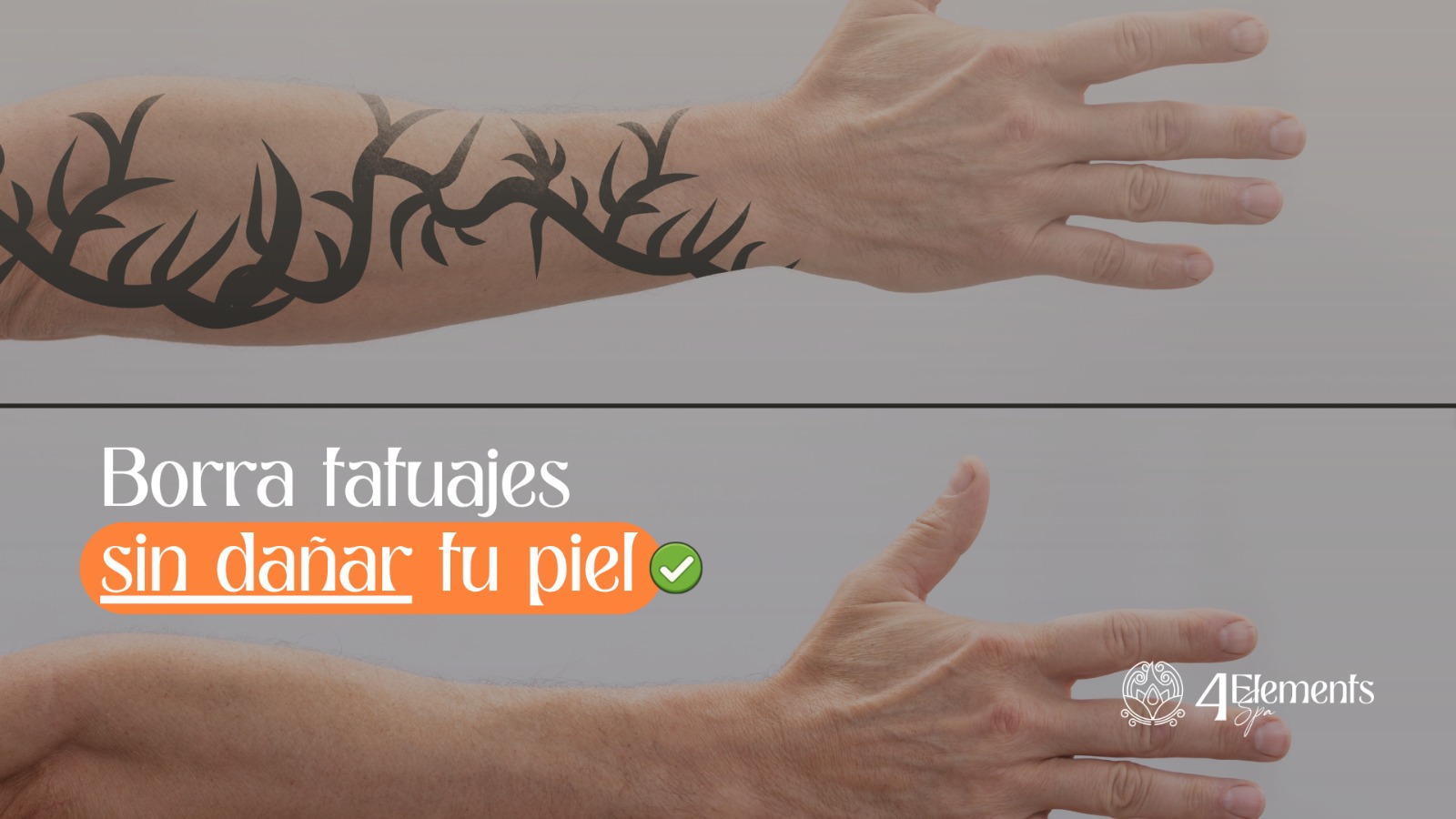
Today, the conversation has shifted thanks to more precise technologies. Among them, the Q-Switched Nd:YAG laser holds a prominent place because it is designed to act on the ink with ultrashort, high-energy pulses, fragmenting it into tiny particles that the body gradually eliminates. That technical precision is precisely what makes it possible to speak of removing tattoos without damaging the surrounding skin. In this article, you will gain a detailed understanding of how this mechanism works, why it does not operate like a laser that “burns,” what the logic behind pigment fragmentation is, and why it is considered one of the safest options for those who wish to eliminate ink in a progressive and controlled manner.
What does removing tattoos without damaging the skin really entail?
Talking about removing tattoos without damaging the skin does not mean promising a magical or instant procedure. It means using a technology capable of focusing its effect on the pigment — not on healthy tissue. In practical terms, the goal is to reduce or eliminate the ink while preserving skin integrity as much as possible.
This encompasses several important points:
| Treatment Objective | What it means in practice |
|---|---|
| Preserving texture | Preventing the skin from becoming rough, sunken, or raised |
| Minimizing scarring | Avoiding deep damage from heat or abrasion |
| Reducing color changes | Lowering the risk of hyperpigmentation or hypopigmentation |
| Maintaining healthy tissue | Not damaging nearby structures that contain no ink |
| Achieving gradual elimination | Allowing the body to participate in clearing the pigment |
Table 1.
The tattoo is located in the dermis, a layer where the pigment becomes trapped beneath the surface. This is why it is not enough to simply “fade” what is visible on top. The treatment must reach the ink at depth — but without turning that path into a destructive injury to the skin.
That is where the true sophistication of the Q-Switched Nd:YAG laser lies: delivering energy in an extremely short period of time so that the primary target is the ink. It does not strip away skin layers or wear down the area; it produces a specific physical reaction on the pigment.
How the Q-Switched Nd:YAG laser works to remove tattoos
The name may sound technical, but its logic is clear when broken down. The Q-Switched Nd:YAG laser emits light energy in ultrashort pulses measured in nanoseconds. That extremely brief duration allows a large amount of energy to be concentrated in a very short period of time.
When the beam makes contact with the tattoo, the following occurs:
- The ink absorbs the laser’s energy.
- That energy generates an intense, localized reaction.
- The pigment fragments into much smaller particles.
- The body’s immune and lymphatic system gradually eliminates those fragments over time.
The most important idea here is that the laser does not “pull” the ink out. Nor does it dissolve it like a chemical would. What it does is break the pigment into pieces small enough that the body can process them more effectively.
This mechanism is one of the reasons why results are not immediate after a single session. The session initiates the physical process of fragmentation, but the actual clearance continues in the weeks that follow, as the body progressively removes the treated particles.
Removing tattoos with ultrashort pulses: why the ink fragments and the skin is preserved
The phrase “ultrashort pulses” is not a minor technical detail — it is the heart of the treatment. To remove tattoos in a controlled manner, exposure time matters just as much as the energy applied.
If an energy source remains on the skin for too long, diffuse heat increases, along with the risk of damaging neighboring tissue. In contrast, when energy is delivered in very brief pulses, the impact concentrates on the pigment before the heat disperses widely.
This generates a predominantly photoacoustic effect — a kind of microscopic mechanical shock that fragments the ink. Put simply: the laser “shakes” the pigment until it breaks apart, rather than cooking the skin to eliminate it.
What happens with each laser pulse:
| Phase | What happens |
|---|---|
| Pulse emission | The device releases energy in a minimal fraction of time |
| Selective absorption | The ink captures that energy with greater intensity |
| Rapid expansion | The pigment undergoes an abrupt physical reaction |
| Fragmentation | Ink clusters break apart into smaller particles |
| Biological clearance | The body begins gradually removing those fragments |
Table 2.
This is why the technology is considered designed to preserve the surrounding skin. The goal is not to destroy everything the tattoo touches, but to convert the ink into treatable fragments without generating widespread thermal damage.
The principle of selective photothermolysis applied to tattoo removal
One of the most important concepts in aesthetic laser medicine is selective photothermolysis. Although the term sounds complex, it describes something very concrete: using light with specific characteristics to affect a particular target without excessively altering neighboring structures.
In the case of tattoo removal, the target is the pigment. The laser is adjusted so that the ink absorbs the energy preferentially. This depends on parameters such as wavelength, pulse duration, and the fluence applied.
Why wavelength matters
Not all inks respond equally to the same wavelength. The Q-Switched Nd:YAG typically works with two well-known references:
- 1064 nm wavelength: Dark pigments such as black and dark blue
- 532 nm wavelength: Some red, orange, and warmer-toned pigments
This helps direct the treatment according to the tattoo’s predominant color. Dark pigments tend to respond better because they absorb certain wavelengths more effectively, while some lighter or more complex colors may require more sessions or respond more slowly.
Selectivity also explains why the procedure can be safer than older alternatives: it does not rely on “stripping” tissue to remove ink, but rather on identifying the pigment as the primary target.
Why the Q-Switched Nd:YAG is designed to preserve the surrounding skin
When a person hears “laser,” they often imagine extreme heat or a kind of controlled burn. In the case of the Q-Switched Nd:YAG for tattoos, that image does not accurately describe the primary mechanism.
This system is designed to preserve the surrounding skin for several reasons:
- Energy concentrates on the pigment: The ink functions as the absorption target. This reduces unnecessary aggression to tissue that contains no pigment.
- The pulse is very brief: Since it operates in nanoseconds, the energy transfer occurs so quickly that it limits thermal diffusion to neighboring structures.
- Elimination is progressive: It does not seek to “remove” the tattoo abrasively in a single session. It fragments it gradually so the body can process it.
- It does not remove skin layers: Unlike dermabrasion or certain mechanical methods, it does not work by scraping the surface.
- It can be adjusted for each case: Not all tattoos require the same intensity. A well-evaluated protocol takes into account skin phototype, color, location, and pigment density.
What types of tattoos respond best to treatment
Not all tattoos behave the same way. Two people wanting to remove tattoos of the same size may still have very different response times. This occurs because elimination depends on many factors that go beyond the patient’s willingness or the number of sessions.
Factors that influence the response:
- Ink type: Some formulations are more resistant
- Color: Darker tones tend to respond better
- Depth: Deeper ink may require more sessions
- Density: Higher saturation generally implies more work
- Age: Older tattoos sometimes respond more quickly
- Location: Areas with better circulation may favor elimination
- Immune system: Influences the body’s ability to clear fragments
Tattoos that tend to respond better
Black, dark blue, or uniformly dense tattoos tend to show better response. Black ink in particular absorbs laser energy very effectively, which facilitates its fragmentation.
More complex tattoos
Multicolor designs, layered touch-ups, fluorescent inks, certain greens and yellows, or tattoos with heavy pigment loads may require more patience. In these cases, removal is still possible, but the process may be slower, with gradual lightening before near-complete elimination is achieved.
Ink colors, depth, and number of sessions
One of the most frequently asked questions is how many sessions are needed. The honest answer is that there is no universal number. The treatment adapts to the biology of the skin and the behavior of the ink.
General response by color:
| Ink color | Typical response |
|---|---|
| Black | Very good |
| Dark blue | Good |
| Red | Variable to good |
| Brown | Variable |
| Green | More complex |
| Yellow | Difficult |
| White | Can be unpredictable |
Table 3.
Advantages of the Q-Switched laser over other tattoo removal methods
Before the widespread adoption of advanced laser technologies, some people turned to techniques that are now considered more aggressive or less predictable. Comparing them helps explain why the Q-Switched became such an important reference.
General comparison:
| Method | How it works | Main disadvantage |
|---|---|---|
| Dermabrasion | Scrapes layers of skin | High risk of scarring and irregular texture |
| Surgical excision | Cuts and sutures the area | Only useful for very small cases and leaves a scar |
| Depigmenting creams | Work superficially | Do not effectively reach dermal ink |
| Home methods | Irritate or damage the skin | High risk and poor results |
| Q-Switched Nd:YAG | Fragments ink with ultrashort pulses | Requires multiple sessions, but with a better safety profile |
Table 4.
Main advantages of the Q-Switched:
- Does not rely on destroying the skin to remove pigment
- Allows for more precise treatment
- Has a safer profile when used with proper evaluation
- Promotes progressive and natural-looking results
- Reduces the risk of scarring compared to invasive methods
For those seeking to remove tattoos without compromising skin quality, this difference is fundamental. It is not just about eliminating ink, but about how the skin looks and behaves after treatment.
What a session feels like and what changes are normal afterward
Many people imagine a long or extremely painful session. In reality, the experience depends on the size of the tattoo, the area of the body, and individual sensitivity.
During application, it is common to feel a brief, repetitive discomfort — sometimes described as small snapping sensations or elastic flicks against the skin. Since the pulses are rapid, the procedure also tends to be relatively quick for small or medium-sized areas.
Immediate changes that may appear:
- Redness
- Localized sensation of heat
- Mild swelling
- Transient whitening of the treated area
- Temporary sensitivity
These reactions do not necessarily indicate damage. They are part of the expected skin response to the controlled laser impact. What matters most is following the aftercare instructions and not manipulating the area.
Care before and after treatment
To remove tattoos with the best possible results, the protocol does not depend solely on the equipment. How the skin arrives to the session and how it is cared for afterward also matters.
Before treatment:
- Avoid intense sun exposure or recent tanning
- Keep the skin clean and free of active irritation
- Inform the specialist about medications, history of abnormal scarring, or skin sensitivity
- Do not apply aggressive products to the area in the days prior
After treatment:
- Keep the area clean and protected
- Avoid scratching, rubbing, or picking at any scabs that may form
- Use sunscreen when the area is exposed
- Follow professional instructions regarding creams or soothing care
- Avoid excessive heat, friction, or direct sun exposure during the initial recovery
When results begin to appear when removing tattoos
Results tend to be gradual. Some people notice early lightening, while others perceive more noticeable changes after several weeks or multiple sessions.
The reason is simple: the session fragments the ink, but the body needs time to eliminate it. That biological process does not occur in a single day. This is why a realistic assessment always prioritizes progression rather than immediacy.
What is typically observed over time:
- Loss of color intensity
- More diffuse appearance of the design
- Area-by-area lightening
- Faster disappearance of some colors and persistence of others
- Gradual reduction of the contrast between the tattoo and the surrounding skin
In many cases, the tattoo removal process advances in layers. Some more superficial particles respond first; others, deeper or denser, require additional time.
The importance of professional evaluation and a personalized protocol
Although the Q-Switched Nd:YAG is a technology designed to respect the skin, the outcome depends on correct application. Having access to a laser is not enough — it is essential to properly evaluate both the tattoo and the skin.
A professional evaluation allows the specialist to define:
- Tattoo type
- Predominant color
- Pigment density
- Skin phototype
- History of the treated area
- Realistic expectations for lightening or elimination
That analysis is key to avoiding unrealistic promises. Removing tattoos is not an identical process for everyone. Some people seek complete elimination; others simply want to lighten the tattoo for a cover-up afterward. In both scenarios, the protocol must be thoughtfully adjusted.
Furthermore, proper guidance helps make clear that “taking care of the skin” is not an empty promotional phrase. It is a technical decision: choosing parameters that prioritize selectivity, respecting biological timelines, and supporting the process with appropriate aftercare.
Conclusion
Removing tattoos without damaging the skin has moved from an aspirational idea to a real possibility, thanks to technologies like the Q-Switched Nd:YAG laser. Its greatest strength lies not only in the fact that it eliminates ink, but in the way it does so: through ultrashort, high-energy pulses that fragment the pigment with precision and allow the body to eliminate it gradually. That mechanism — based on selectivity and control — is why this technology is considered one of the safest options for those who wish to treat a tattoo without resorting to abrasive or destructive methods.
Rather than removing layers of skin, the laser works on the pigment as its primary target, reducing unnecessary thermal damage and helping preserve the natural texture of the area. Understanding this process completely changes the perspective on treatment. It is no longer about “removing a tattoo at any cost,” but doing so with a strategy that respects skin biology, advances session by session, and prioritizes both the aesthetic result and the health of the skin.
Frequently Asked Questions
1. Can the Q-Switched Nd:YAG laser really remove tattoos without leaving a scar? The Q-Switched Nd:YAG laser is designed to minimize the risk of scarring as much as possible because it does not work by removing layers of skin, but by selectively fragmenting the pigment. This allows the surrounding tissue to remain largely intact. However, the final result also depends on factors such as correct application of the treatment, the type of tattoo, and proper adherence to aftercare. When all of these elements come together correctly, the likelihood of visible scarring is very low compared to more invasive methods.
2. How many sessions are needed to completely remove a tattoo? The number of sessions varies based on multiple factors, so there is no single figure applicable to all cases. Elements such as ink color, the depth at which it was implanted, pigment density, and the age of the tattoo all directly influence the process. Each person’s immune system response also plays a role, as it is responsible for eliminating the ink fragments. For this reason, some people may see faster results, while others require longer treatment to achieve significant lightening or near-complete elimination.
3. Why doesn’t all the ink disappear after the first session? This occurs because the laser does not eliminate the ink immediately — it breaks it down into smaller particles. Once fragmented, the body takes over, gradually processing and eliminating those particles through the lymphatic system. This biological process takes time and cannot be drastically accelerated without compromising skin health. This is why results appear progressively between sessions, with each application continuing to weaken the remaining pigment.
4. Do all colors respond the same way to treatment? Not all colors react to the laser in the same way, due to differences in how they absorb energy. Darker tones, such as black or deep blue, tend to respond better because they capture laser energy more readily. In contrast, colors such as green, yellow, or certain more complex mixtures can be more resistant and may require more sessions to achieve visible results. This does not mean they cannot be treated, but the process may be more gradual and requires a more patient approach.
5. What makes the Q-Switched Nd:YAG different from older tattoo removal methods? The main difference lies in how it acts on the tattoo. While older methods relied on removing layers of skin or generating controlled damage to extract the pigment, the Q-Switched Nd:YAG works with precision on the ink using ultrashort pulses. This significantly reduces the impact on healthy tissue and allows for a more selective approach. As a result, the treatment is safer, carries a lower risk of scarring, and better preserves the natural texture of the skin.