
Index
- Introduction: The growing demand for tattoo removal
- What is laser tattoo removal?
- The Spectrum Laser and its Q-Switched technology
- What makes the Q-Switched laser special?
- Technical process
- Tattoo removal: Comparison with older methods
- Technical Comparison
- Benefits of Professional Laser Treatment for Tattoo Removal
- How Many Sessions Are Really Needed?
- Factors That Determine the Number of Sessions
- Estimated Number of Sessions by Tattoo Type
- Intervals Between Sessions
- Post-Treatment Care and Possible Side Effects
- Immediate Care After Each Session
- Common and Temporary Side Effects
- Final Conclusion
- Frequently Asked Questions
Introduction: The growing demand for tattoo removal
Tattoos have gone from being a marginal form of expression to a massive trend around the world. However, as their popularity has increased, so has the number of people who, for personal, professional, or aesthetic reasons, seek tattoo removal.
Whether due to a poorly executed design, changes in personal life, or simply a desire to renew the skin, medical lasers have established themselves as the safest and most effective tool for permanently removing tattoos. In Mexico, the use of advanced platforms such as the Spectrum Laser has raised treatment standards, offering remarkable results without putting skin health at risk. In this article, you will learn how this technology works, what to expect from the treatment, and why it is superior to any other method.
What is laser tattoo removal?
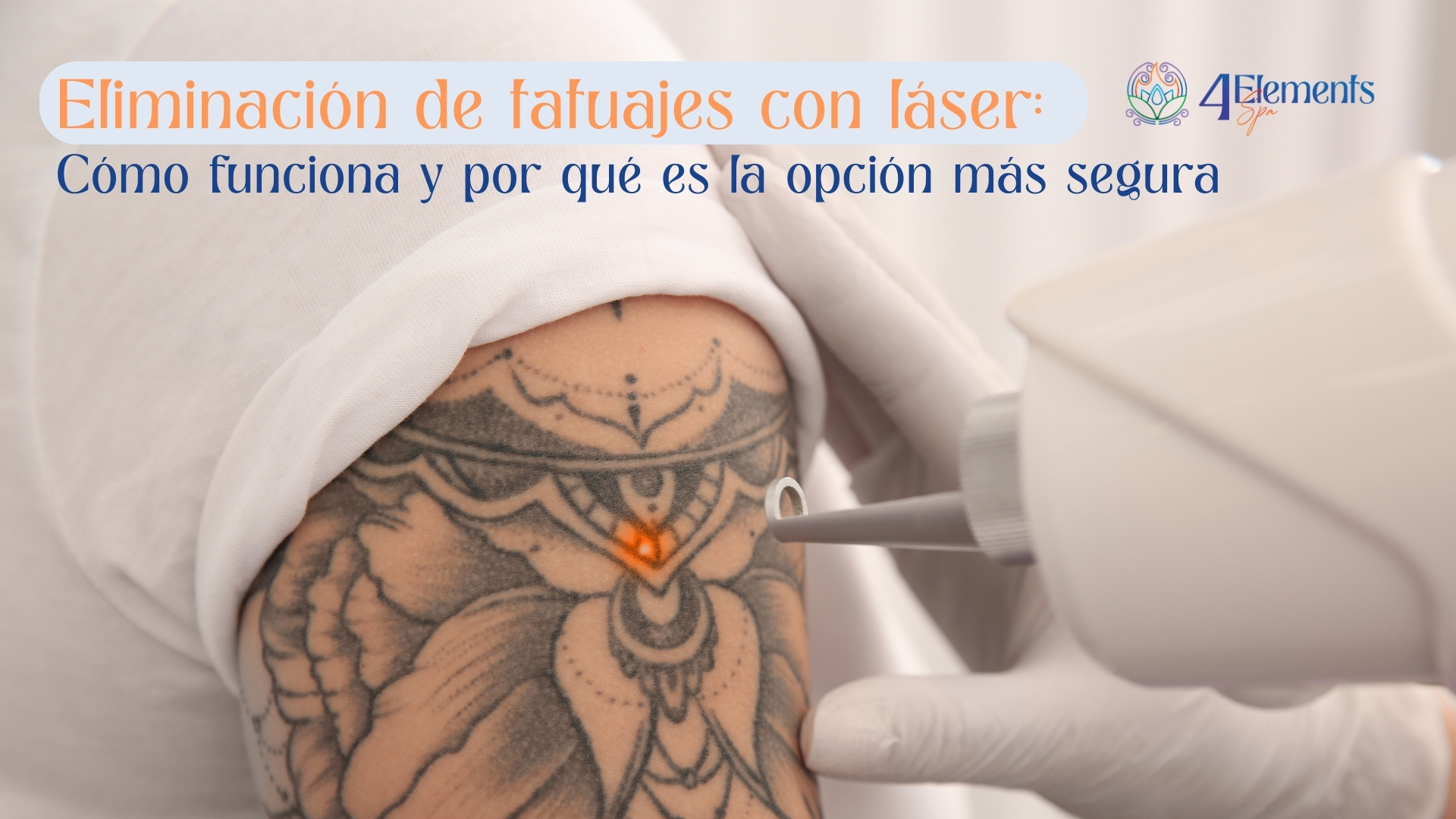
Laser tattoo removal is a non-invasive procedure that uses concentrated pulses of light to break down ink particles within the skin. Contrary to popular belief, the laser does not burn or extract the ink, but rather acts on the pigments at a molecular level.
Tattoo ink is lodged in the dermis, the middle layer of the skin, where white blood cells cannot reach it. The laser emits pulses with a specific wavelength that breaks down the ink particles into microfragments. The body’s lymphatic system then naturally eliminates these residues over time. This process is repeated in several sessions, depending on the color, depth, and size of the tattoo.
The Spectrum Laser and its Q-Switched technology
The Spectrum Laser is a multifunctional platform used in advanced aesthetic treatments. This system integrates five different laser technologies, adaptable to multiple dermatological conditions. One of its most notable technologies for tattoo removal is the Q-Switched laser, renowned for its precision and safety.
What makes the Q-Switched laser special?
- High-energy pulses in nanoseconds: These ultra-fast bursts disintegrate the ink without causing significant thermal damage.
- Minimal skin aggression: Unlike other methods, no layers of skin are removed and no abrasion is generated.
- Multicolor capability: It can remove dark and light pigments, even inks such as green or blue, which other lasers cannot reach.
- Precise penetration: It works at the exact depth where the ink is located, without affecting the epidermis.
Technical process
- Laser application: The pulse penetrates without damaging the surface.
- Fragmentation: The ink particles break down.
- Natural removal: The body expels the debris through the lymphatic system.
- Regeneration: The skin heals progressively between sessions.
This principle is also successfully applied in other Spectrum Laser treatments, as detailed in how Spectrum Laser vascular treatment works and why it is effective, reinforcing the versatility and safety of this platform.
Tattoo removal: Comparison with older methods
Before the development of state-of-the-art laser technology, those who wanted to get rid of a tattoo resorted to methods such as:
- Depigmentation creams
- Chemical peels
- Dermabrasion
- Excision surgery
- Improvised home techniques
Technical comparison
| Method | Effectiveness | Risks | Scarring | Recovery time |
| Q-Switched laser | High | Low | Rare | 5 to 10 days per session |
| Bleaching creams | Very low | High (allergies) | Likely | Slow |
| Chemical peels | Medium | Medium (burns) | High probability | Prolonged |
| Dermabrasion | Medium-low | High (pain, bleeding) | Common | Long recovery |
| Surgery | Partial | Very high | Always leaves a scar | Prolonged |
Table 1. Direct comparison with other tattoo removal methods.
Creams, for example, do not remove the ink, but act on the surface of the skin, causing irritation without any real results. Peeling and abrasion can cause permanent damage and do not guarantee complete pigment removal.
In contrast, the Q-Switched laser acts specifically on the ink without affecting the healthy layers of the skin. It is the only medically approved method that offers measurable, controlled, and safe results.
Benefits of professional laser treatment for tattoo removal
Choosing professional tattoo removal treatment with Q-Switched laser has advantages that go beyond aesthetics:
- Proven high effectiveness
- Preservation of healthy skin
- No need for incisions or general anesthesia
- Compatibility with all skin types
- Progressive reduction of the tattoo from the first session
- Technology approved by international health authorities
In addition, the same principle of action of the Q-Switched laser has shown excellent results in other dermatological applications, such as the treatment of hyperpigmentation with advanced laser technology, which speaks to its versatility and reliability.
How many sessions are really needed?
One of the key points to consider when thinking about laser tattoo removal is that it is not an immediate process, but a gradual one. The ink is removed progressively, session after session, respecting the skin’s healing time and the natural rhythm of the lymphatic system, which processes the pigment fragments.
Factors that determine the number of sessions
- Tattoo color: Black tattoos are easier to remove. Green, red, and blue tattoos require more sessions.
- Ink depth and density: Very dense tattoos or those with multiple layers require more work.
- Body area: Limbs usually take longer than areas close to the heart due to circulation.
- Age of the tattoo: Older tattoos tend to fade more easily.
- Skin type: Lighter skin usually responds better, but the Q-Switched laser can be adapted to different skin types.
Estimated number of sessions by tattoo type
- Black, small, amateur: 3–5
- Black, professional, medium: 5–8
- Multicolor, professional, large: 8–12 or more
Intervals between sessions
It is recommended to wait 6 to 8 weeks between sessions in order to:
- Allow the body to eliminate ink residue.
- Avoid inflammation or adverse reactions.
- Observe results before continuing.
This time also helps the specialist evaluate how the skin responds and determine if it is necessary to adjust the laser energy or pulse type.
Post-treatment care and possible side effects
Although the Q-Switched laser has an excellent safety profile, it is essential to follow a care routine after each session to maximize results and avoid side effects.
Immediate care after each session
- Apply cold compresses for the first few hours to reduce inflammation.
- Use a regenerative or antibiotic cream recommended by your specialist.
- Avoid direct sun exposure for at least 15 days.
- Do not scratch or rub the treated area.
- Use SPF 50+ sunscreen for several weeks.
- Keep the area clean and dry, especially if small blisters appear.
Common and temporary side effects
| Effect | Description | Expected duration |
| Redness | Normal superficial inflammation | 24 – 72 hours |
| Small blisters | Sign of thermal action of the laser | 2 – 5 days |
| Scabs | Part of the regeneration process | 7 – 10 days |
| Temporary darkening of ink | Partially fragmented pigment | 1 – 2 weeks |
| Hyperpigmentation or hypopigmentation | Rare, more common in dark skin | May last for weeks |
Table 2. Common and temporary side effects.
Note: In the hands of professionals, the risk of permanent scarring is minimal. The key is to follow medical advice and avoid home remedies or self-medication.
Final conclusion
Removing a tattoo is no longer synonymous with pain, scarring, or unsafe treatments. Thanks to advances in cosmetic dermatology and technologies such as the Q-Switched laser from the Laser Spectrum system, it is now possible to remove tattoos gradually, effectively, and safely.
Choosing a clinic with certified technology, trained staff, and proven experience ensures that the process is gentle on your skin, with visible results from the very first sessions. Not all tattoos are removed in the same way, but the treatment can be customized to your needs. If you are looking for a professional option to remove a tattoo, be sure to go to experts with state-of-the-art medical technology.
Frequently asked questions
- Can I remove any type of tattoo with laser treatment? Yes, virtually any tattoo can be treated with laser, whether professional, amateur, or even those done with unconventional techniques. Effectiveness depends on several factors such as color, depth, and type of ink used. Black ink tattoos are usually easier to remove, while colors such as green, blue, or red may require more sessions due to the way they absorb laser light. However, thanks to the versatility of the Q-Switched laser, excellent results can be achieved on a wide range of tattoos. A preliminary assessment is important in order to design a specific protocol for each patient.
- Does laser treatment hurt? The level of discomfort is tolerable for most patients and is often described as a sensation of small elastic shocks or as if a rubber band were repeatedly hitting the skin. The intensity of the pain may vary depending on the area treated, the size of the tattoo, and individual sensitivity. Areas such as the ribs or ankles may be more sensitive than others. For added comfort, a topical anesthetic cream can be applied before each session. This helps to significantly reduce discomfort without interfering with the effectiveness of the treatment.
- Can I work after a session? Yes, in most cases you can resume your work activities on the same day. Laser tattoo removal is an outpatient procedure that is non-invasive and does not require downtime. After the session, it is common for the skin to show redness, mild swelling, or a feeling of warmth in the treated area, but these effects usually disappear within a few hours. The only recommendations are to avoid direct sun exposure, refrain from intense physical exercise on that day, and not apply cosmetics or chemicals to the skin until the specialist indicates otherwise.
- When will I see results? The results begin to be visible gradually. In many cases, after the second or third session, a noticeable fading of the tattoo can be seen. However, each skin type and each type of ink reacts differently. The full effects of the treatment are only seen after several sessions, which can take several months. Between sessions, the body continues to work to eliminate the ink fragments that the laser has destroyed, so the improvement is constant even when you are not undergoing active treatment.
- Is it possible that the tattoo will not be completely removed? In some specific cases, yes, although it is rare. Some tattoos, especially very old ones made with industrial or homemade inks, may leave a slight shadow or residue called a “ghost tattoo,” which is a slight residual pigmentation. It also depends on whether the tattoo was done very deeply or if the inks contain heavy metals that are difficult to break down. However, with advanced technology such as Q-Switched lasers and a proper protocol, it is possible to achieve nearly 100% removal in most cases. The key is to go to specialized centers with proven experience.